The Home Planetarium
How to put the night sky back on your ceiling.
I live in inner Sydney, which scores a 9 out of 9 on the Bortle scale of light pollution. I can see a handful of constellations on a clear night, and only the brightest planets. I have never seen the Milky Way from home.
Over 100 billion humans have ever lived. Only around 2 or 3 billion of them have been unable to see the Milky Way from where they live. For the other hundred billion or so, it was just there every night, a river of light stretching across the whole sky. They must have stared up at it constantly. They must have wondered what on earth it was. The ancient Greeks called it galaxías kýklos, the milky circle. Every culture had a name for it and a story about it, and none of them came close.
Then over the course of the 20th century, we worked it out: it’s a side-on view of a spinning disc of hundreds of billions of solar systems, one of which is ours. We invented a word for the structure: galaxy, from the Greek for milk. The real answer turned out to be more extraordinary than anything anyone had imagined.
The same development that gave us the telescopes and the science to figure this out also gave us streetlights, cities, and light pollution. The generation that finally understood what the Milky Way is, is the first one that mostly can’t see it.
I wanted it back. Not just on holidays somewhere dark, but in my apartment, every night. So I spun up a bunch of AI agents to research every star projector, galaxy projector, and home planetarium on the market and tell me which ones are actually worth buying. This is what they found.
Quick picks
Best overall
BlissLights Sky Lite 2.0
Real laser stars, a real brand, under fifty bucks. The only ambient projector whose stars actually look like the marketing photos.
Best real sky
Sega Homestar Flux
Looks better in person than in photos, which almost never happens. 60,000 pinpoint stars, sharp enough to pick out constellations.
Best for kids
Cloud b Twilight Turtle
All-LED, no laser, cool-touch. Has a 45-minute auto-off so you don't have to creep back in to turn it off.
Your Night Sky — coming soon
I'm building a tool that generates a map of the exact sky above any place on any date. The night you were born, the night you got married, whatever. Print it or explore it interactively. Not ready yet, but if you want to know when it is:
One email the day it launches. Nothing else.
Star projector comparison
Based on actual research and real-user reports, not scraped spec sheets.
| Model | Real sky? | Coverage | Timer | Noise | Price | Best for |
|---|---|---|---|---|---|---|
| Sega Homestar Flux | Yes | ~9x9ft (short throw) | 30/60min | Silent | $$$ | Real star field |
| Nat Geo / Bresser Astro | Yes | ~8ft diameter | 30/60/120min | Motor hum at speed | $$ | Date-accurate sky, budget |
| BlissLights Sky Lite 2.0 | No | ~30x30ft (stars) | 1/2/4hr | Quiet | $ | Best value ambient |
| BlissLights Sky Lite Evolve | No | ~30x30ft (stars) | 1/2/4hr | Whisper | $$ | Living colour nebula |
| Cloud b Twilight Turtle | Yes | ~6ft radius | 45min auto-off | Silent | $ | Nursery / youngest kids |
| Glow-in-the-dark stars | No | As many as you stick | Passive (hours) | None | $ | Zero-electronics simplicity |
The collection
Six star projectors out of dozens I looked at. The rejects are in the FAQ if you’re curious why.
An accurate sky — home planetarium projectors
These project real constellations from astronomical discs, and they’re the only tier where the real thing looks betterthan the photos. One thing to know: the sharp star-field discs are dim and colourless (that’s what a real sky looks like). The vivid Milky Way shots you see online are from photographic galaxy discs, which are basically printed astrophotos being projected. Different thing entirely.
Sega Homestar Flux
~US$200-280
~A$300-400
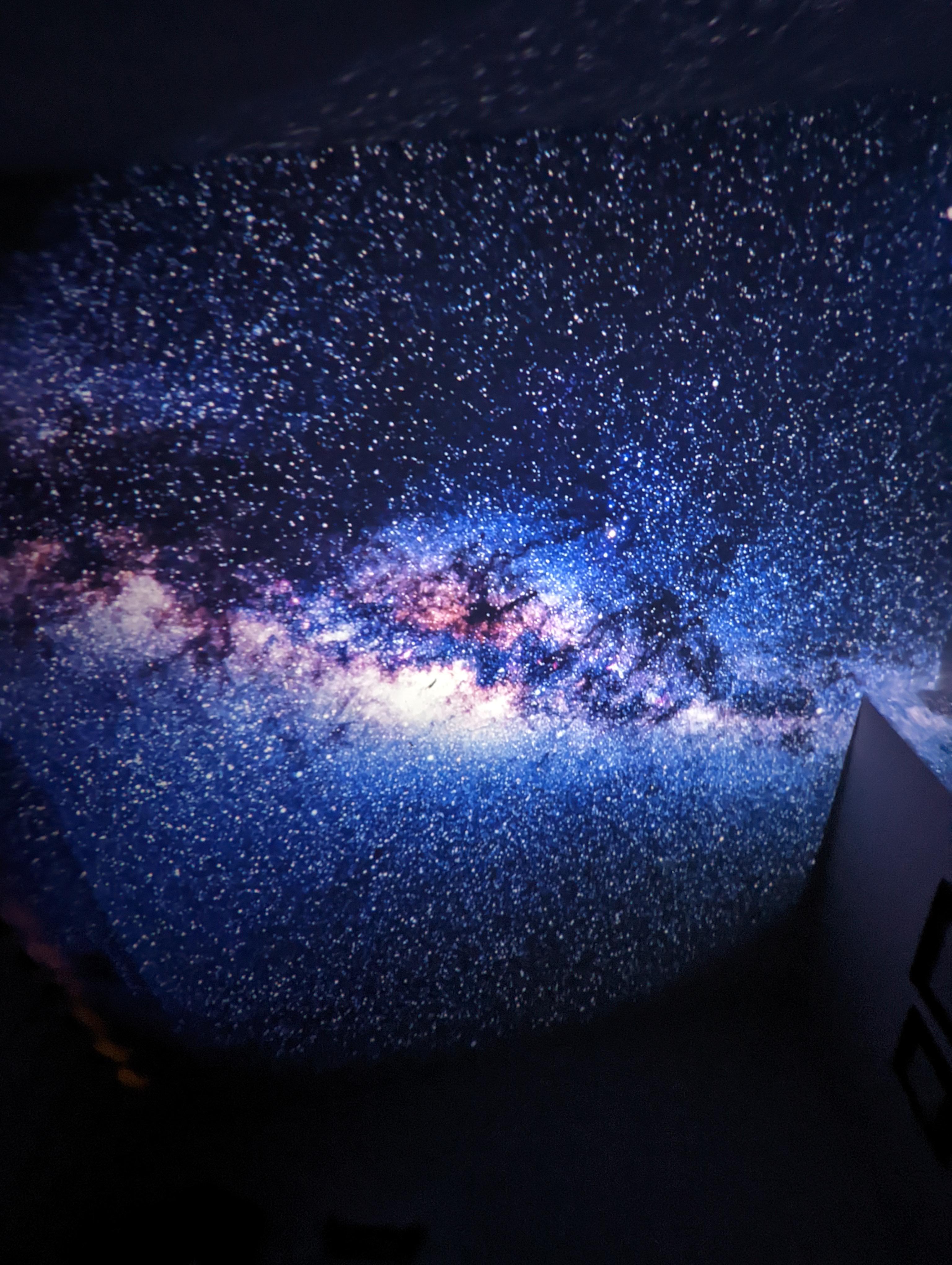
Photo: r/spaceporn
The best option for actual constellations. Glass lenses, 60,000+ stars on the premium discs, and it's bright enough that you don't need total darkness. Photographs worse than it looks, which is the opposite of the ambient projectors below.
What’s good
- +Sharpest projection in the category, pinpoints not blobs
- +Bright enough to use with a bit of ambient light
- +Silent rotation, runs cool
- +The shooting-star toggle is a nice touch
- +Solid build quality
The honest cons
- –Expensive for what is, ultimately, a ceiling projector
- –The focus wheel barely responds. Multiple reviewers thought theirs was broken
- –Some reports of the rotation motor dying around year two
▶10 sources
- r/spaceporn2022-09
- r/Astronomy2025-05
- r/Astronomy2022-12
- r/space2019-11
- r/Stargazing2023-08
- r/Astronomy2024-10
- r/SEGA2024-09
- r/amazonreviews2020-07
- r/Astronomy2021-02
- r/projectors2025-01
National Geographic / Bresser Astro Planetarium
~US$60-99
~A$90-150
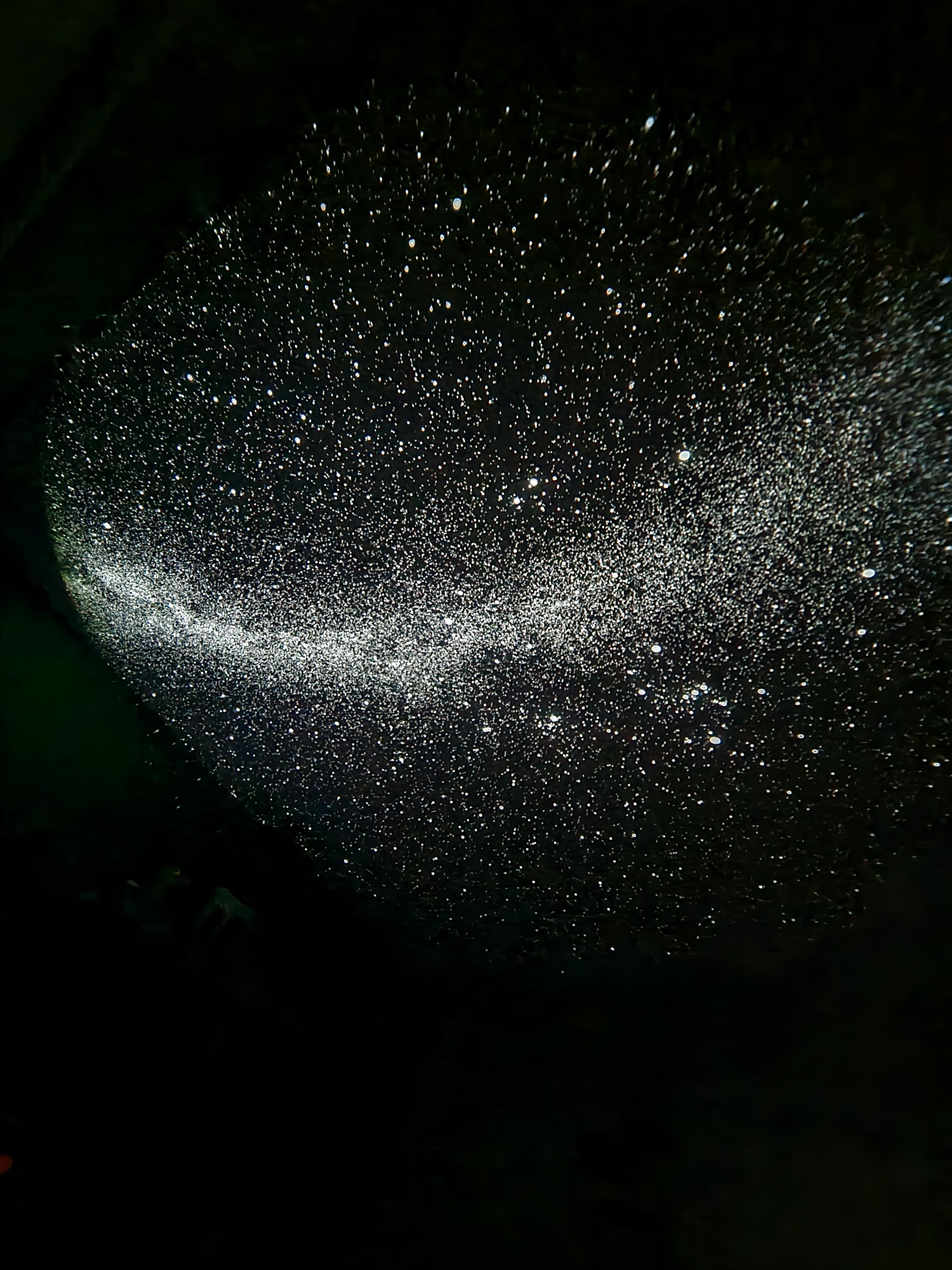
Photo: r/spaceporn
Budget pick for real constellations. It has a time-and-date dial that lets you set tonight's actual sky, which is a feature no other unit here offers out of the box. Bresser optics are decent: sharp in the centre, softens at the edges. A third of the Homestar price.
What’s good
- +Date-accurate constellations via built-in dial
- +Under A$150
- +Runs on mains or 3xAA batteries
- +Easy to find in AU: BIG W, Toys R Us, Amazon AU
The honest cons
- –Rotation motor is noisy
- –Speaker is wired 3.5mm, not Bluetooth
- –The shooting-star effect is a fixed spot, looks a bit naff
- –Noticeably dimmer than the Homestar
▶4 sources
- r/telescopes2025-02
- r/hyderabad2025-09
- r/Hue2020-01
- r/amazonprime2024-11
Ambient cosmos — galaxy & nebula projectors
Galaxy projectors, nebula projectors, laser starfields. Every promo image you’ve seen is a long-exposure photo or a CGI render. Your eyes will see maybe 40% of that. They need a dark room. But the ones with real laser optics (not fuzzy LEDs) make genuinely nice mood lighting, and they’re cheap. Two brands consistently design their own optics and firmware: BlissLights and Govee. Most of the rest share the same rebadged OEM shell. Some are sold as aurora projectors, but none of them actually reproduce aurora ribbons.
BlissLights Sky Lite 2.0
~US$40-60
~A$28-40 on sale
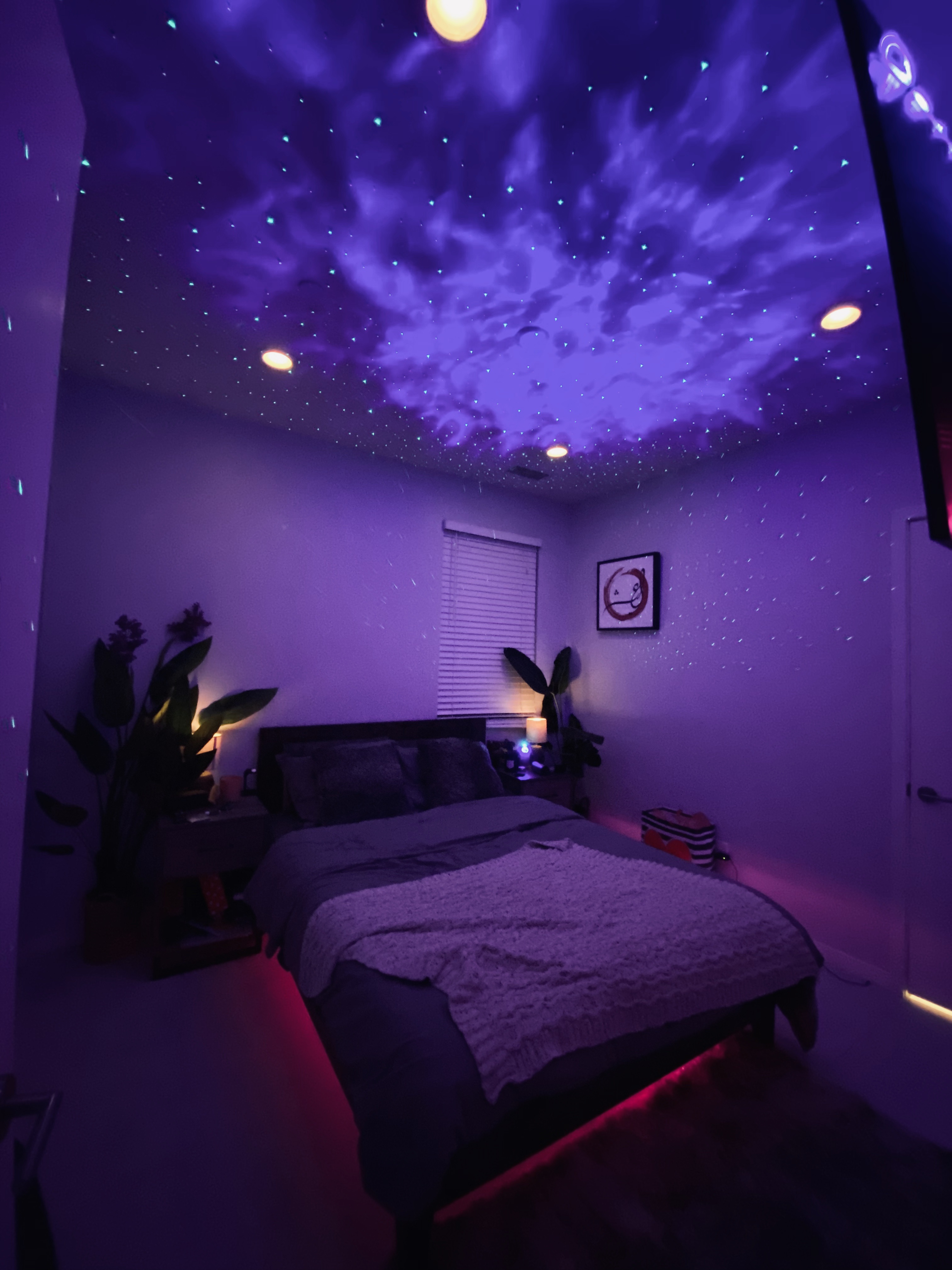
Photo: r/TripCaves
Best bang for dollar in the whole collection and it's not close. Uses a real diode laser for the stars, so you get sharp pinpoints across a 30-foot ceiling instead of the fuzzy LED blobs every cheap clone produces. The nebula cloud looks better in photos than in person, but the stars genuinely deliver. Routinely drops under A$30 on OzBargain.
What’s good
- +Real diode laser, sharp star pinpoints
- +Fills a bedroom ceiling (~30x30ft coverage)
- +Actually has a brand, a website, and a warranty
- +Routinely under A$30 on sale
The honest cons
- –Nebula is dimmer to your eye than every photo suggests
- –The weighted inline power button drags the unit around on smooth surfaces
- –Needs a dark room
- –Has a laser, so not safe for unsupervised infants
▶8 sources
- r/TripCaves2020-06
- r/TripCaves2023-10
- r/TripCaves2020-07
- r/TripCaves2021-11
- r/TripCaves2023-02
- r/Hue2020-01
- r/LSD2022-01
- r/TripCaves2026-05
BlissLights Sky Lite Evolve
~US$70-99
~A$100-130
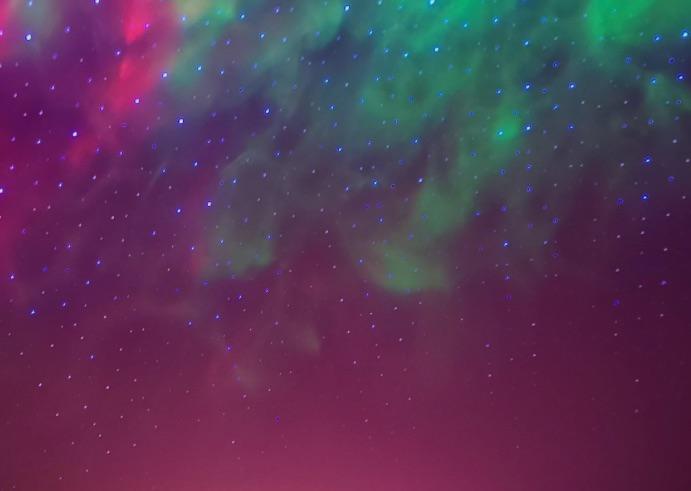
Photo: r/TripCaves
The upgrade over the 2.0. Swaps the static nebula for a colour-blend that shifts slowly, which gets closer to the aurora look people want (though no projector actually does aurora ribbons). Same laser star quality, quieter motor. Whether that's worth nearly double the price is the real question.
What’s good
- +Colour-blend nebula that shifts slowly, looks good
- +Quietest unit in the ambient tier
- +Same real-laser stars as the 2.0
The honest cons
- –Nearly double the price for an incremental improvement
- –Same weighted-button drag problem as the 2.0
- –Shell feels fragile
▶4 sources
- r/TripCaves2023-10
- r/TripCaves2024-06
- r/TripCaves2022-12
- r/projectors2023-12
For the youngest stargazers — star projectors for kids
Safety and durability matter more than brightness here. Dim-and-warm is a feature, not a compromise.
Cloud b Twilight Turtle
~US$30
~A$49-59
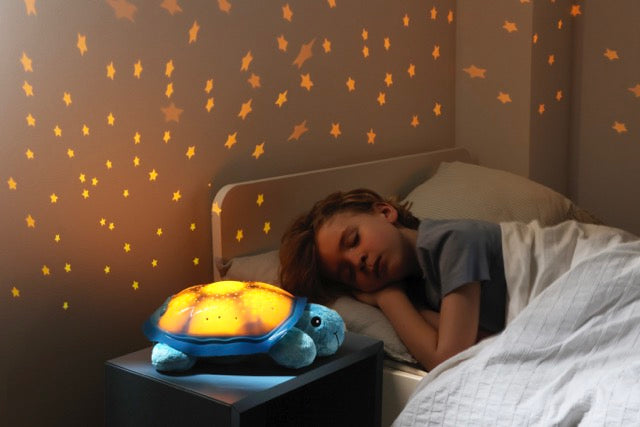
Photo: cloud.b
The nursery pick. 100% LED, cool-touch, no laser. Warm amber, blue, or green glow with 8 real constellations on the ceiling. The 45-minute auto-off is the whole point: it turns itself off so you don't have to sneak back in. Built to survive being thrown.
What’s good
- +100% LED, Class 1, genuinely nursery-safe
- +45-minute auto-off (the feature parents actually care about)
- +Cool-touch, survives toddler abuse
- +Projects real constellations (8 patterns)
The honest cons
- –Battery contacts can be dodgy out of the box (fixable but annoying)
- –Eats AA batteries, not rechargeable
▶5 sources
- r/BabyBumps2020-05
- r/beyondthebump2015-11
- r/Buyingforbaby2026-06
- r/HelpMeFind2024-05
- r/Lamps2021-07
Glow-in-the-dark stars (strontium aluminate)
~US$10-20
~A$20-35
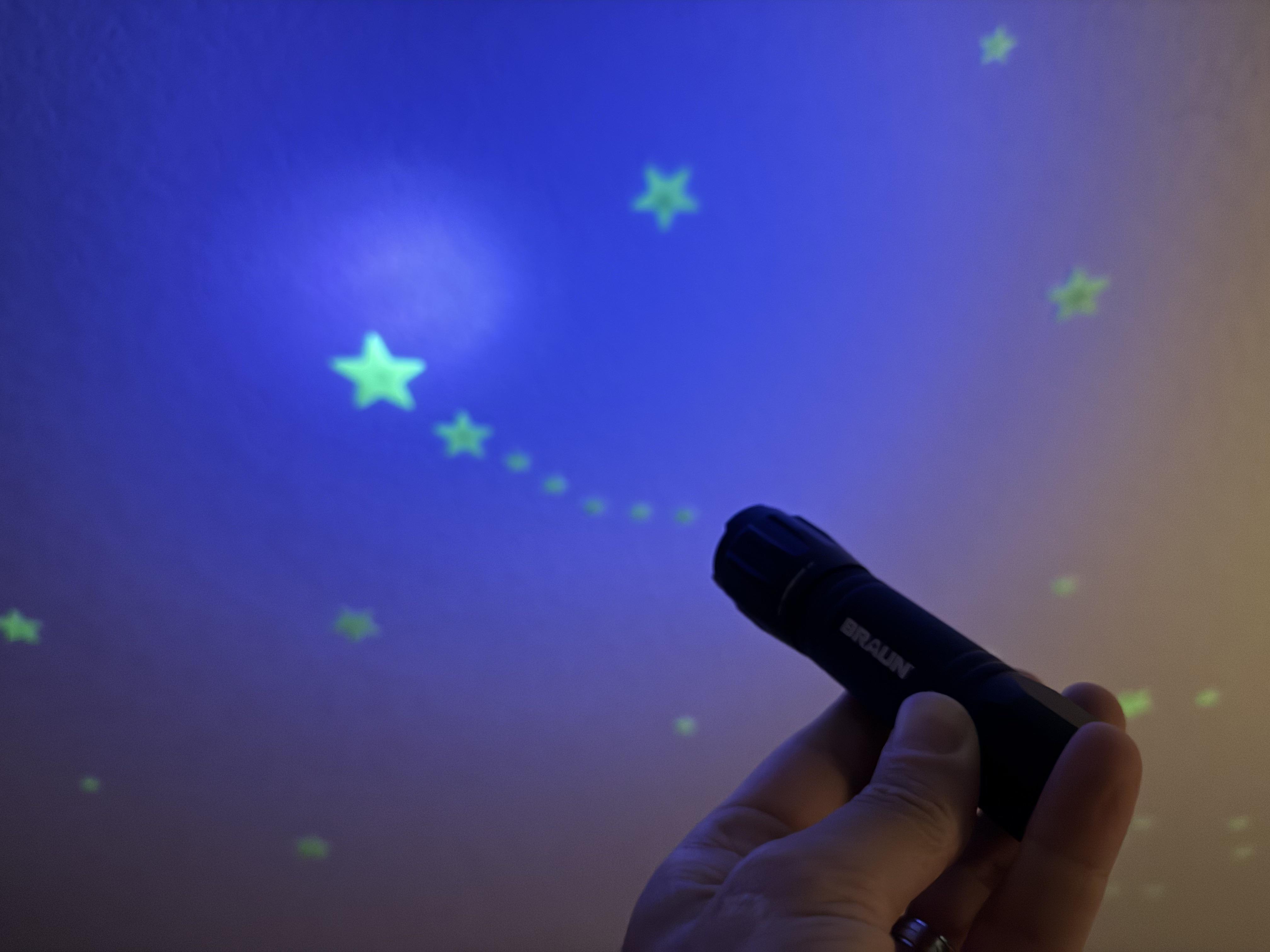
Photo: r/daddit
No electronics, no batteries, nothing to break. Just stick glow-in-the-dark stars on the ceiling. The only spec that matters is the material: you want strontium aluminate (SrAl2O4:Eu,Dy), which glows for hours. The cheap zinc-sulfide ones fade in minutes. Don't buy by brand, buy by material. Charge under any light, glow all night.
What’s good
- +Zero risk. No electronics, no heat, no moving parts
- +Strontium aluminate glows for hours, not minutes
- +Under A$35
The honest cons
- –Static, obviously. No rotation, no colour
- –Need a dark room and a charge period under bright light
- –The adhesive can mark painted ceilings when you pull them off
▶5 sources
- r/TripCaves2024-07
- r/nostalgia2025-05
- r/nostalgia2018-08
- r/daddit2024-10
- r/BabyBumps2019-05
Ready to see the real thing?
A projector puts an image on your ceiling. The actual sky is right outside and it’s better. If you want to go from projector to real stargazing, here’s the short version.
Start with binoculars, not a telescope.Every astronomer says this and they’re right. A pair of 10x50 binoculars costs under A$200, needs no alignment or software. Point them at the Moon, see craters. Point them at the Pleiades, see dozens of stars you missed. Use them for birds the next morning.
When you want a telescope, get a Dobsonian reflector. A 6″ or 8″ Dob costs A$550–900 and shows you Saturn’s rings and Jupiter’s cloud bands with your own eyes. I’m putting together a proper stargazing equipment guide as the next Cabinet collection.
That telescope collection is coming. Get notified when it lands.
Frequently asked questions
A projector on the ceiling is a weird substitute for the actual sky. But I like it. I hope something here helps you find one worth buying.
Get the next thing I make
I’m building a night sky mapping tool, and a telescope collection is next. Sign up above to know when they’re ready.