Imagine you are
an intergalactic
gem hunter...
Which gemstones are common across the universe?
Which are vanishingly rare?
Voyager 1
We can actually estimate this. This is the bubble of solar wind around our Sun — Voyager 1 just barely crossed its edge. How much of each gem could you fit inside it?
Ruby & Sapphire
Born in the atmospheres of dying stars
Corundum — the mineral that gives us both rubies and sapphires — is one of the first minerals to crystallise from a cooling stellar wind. The same crystal, coloured red by chromium or blue by iron and titanium.
Garnet
Crushed into existence in the deep mantle of every rocky planet
Any world big enough to have pressure has garnet — from 250 to 600 km down. The universe is full of rocky worlds.
Diamond
Rained from methane skies, scattered through interstellar dust
Carbon — the fourth most abundant element — becomes diamond wherever pressure and temperature align. The universe provides both generously.
Quartz & Amethyst
Crystallised wherever silica and water meet inside a cooling crust
Rarer than raw mantle minerals, but still staggeringly common across trillions of rocky planets. Amethyst is just quartz with a trace of irradiated iron.
Zircon
Crystallised 4.4 billion years ago — and survived everything since
Zircon crystals are the most durable timekeepers in geology. The oldest material ever found on Earth is a zircon grain from Western Australia, 4.4 billion years old. Zirconium is a trace element cosmically, but trillions of rocky worlds each contribute their share.
Jadeite
Forged in the collision zones of tectonic plates
Not every rocky world has plate tectonics, but enough do. Imperial jade — the vivid green variety — requires a chromium trace that makes it genuinely uncommon.
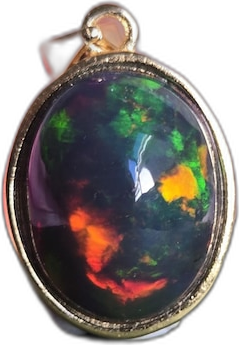
Opal
Silica dissolved in water, settled into a lattice that splits light into fire
It requires a world with liquid water — a far rarer condition than most people realise. Opal has been detected on Mars.
Part II
Now things get genuinely rare. These piles may look large — but this is all there is, everywhere.
Everything below needs beryllium — an element stars can't make. It's created only when cosmic rays shatter heavier atoms at near-light speed.
Emerald
Built from cosmic ray debris — beryllium, an element stars can't make
Every emerald in existence started as atomic shrapnel. The beryllium bottleneck means emerald can never be cosmically common — no matter how many rocky worlds there are.
Red Beryl
The same impossible element, plus one more coincidence
Same beryllium bottleneck as emerald, plus manganese inside a very specific type of rhyolitic lava flow. On Earth, there's one commercial deposit — in Utah. But trillions of rocky worlds each roll those dice. One red beryl crystal for every 150,000 gem diamonds.
Taaffeite
Four reluctant elements, forced into a crystal that almost never forms
First discovered in 1945 — already cut and polished, sitting in a jeweller's box, mistaken for spinel. Fewer than a thousand faceted stones are known on Earth. The crystal structure almost never nucleates — but across enough worlds, almost never still adds up.
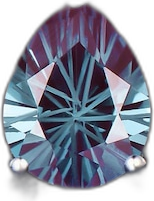
Alexandrite
Beryllium from the crust, chromium from the mantle — they almost never meet
When they do meet, you get a gem that changes colour from green to red depending on the light. Geochemical enemies producing something beautiful.
Benitoite
Barium-rich fluids altering serpentinite under exact pressure and temperature
On Earth, gem-quality benitoite comes from one county in California. The mine closed in 2006. But the geology that made it — serpentinite, barium, heat — isn't unique to Earth. Across trillions of worlds, similar accidents add up.
Part III
One planet.
Everything below was made by life. You're surrounded by some of the rarest stuff in the universe.
Wood
Grown by living organisms, ring by ring, on only one planet
There are about 3 trillion trees on Earth, holding roughly 450 billion tonnes of wood. That sounds like a lot — until you remember that diamond exists on trillions of worlds. Wood exists on one. By cosmic measure, a wooden ring is roughly thirty orders of magnitude rarer than a diamond one.
Ammonite
340 million years of ocean life, fossilised in stone
Ammonites ruled Earth's oceans for over 300 million years before the asteroid that killed the dinosaurs wiped them out too. Their spiralling shells are embedded in marine rock across every continent. But they only ever existed here.
Shell & Nacre
Aragonite bricks, mortared by a living animal, thinner than a wavelength of light
Nacre is aragonite crystals laid down in microscopic brick-and-mortar layers by living mollusks. No geological process produces it. Only life does.
Petrified Wood
Trees turned to stone, cell by cell
Silica-rich groundwater slowly replaces every cell of a buried tree with quartz, preserving the grain, the rings, even the bark.
Jet
Fossilised driftwood from the Jurassic
Jet is ancient conifer wood, compressed under ocean sediments for 180 million years until it became a hard, lustrous black stone. Queen Victoria made it famous as mourning jewellery. It is fossilised biology — doubly rare.
Amber
Ancient tree blood, hardened by time
Amber is fossilised tree resin — not sap, but the sticky defensive secretion trees produce when wounded. The Baltic deposit alone holds an estimated 640,000 tonnes, laid down 44 million years ago in a vast forest that no longer exists. All of it: one planet.
Precious Coral
Built by tiny animals, colony by colony
Precious coral — Corallium rubrum — is not reef coral. It's a slow-growing deep-water animal that builds a dense, polishable skeleton of calcium carbonate. Mediterranean fishers have harvested it for millennia. Populations have crashed 80% since the 1970s.
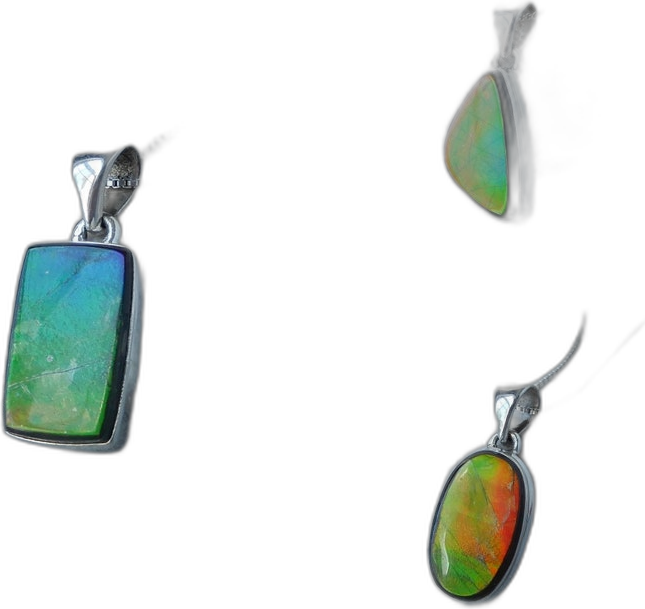
Ammolite
One extinct species, one river in Alberta, 70 million years underground
The iridescent shell of one extinct ammonite species, found in a narrow belt along the St. Mary River. Gem-grade material may run out within decades.
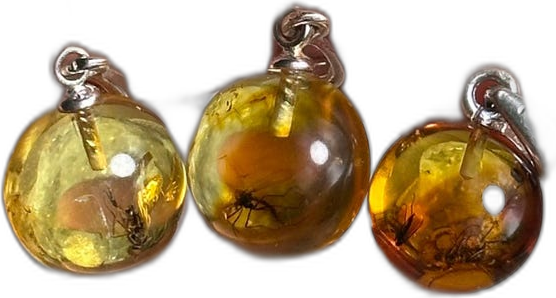
Amber with Insect
A whole creature, frozen in tree resin for 40 million years
Only about one in a thousand pieces of amber contains an insect. Of those, only 10% are well-enough preserved to identify. Each one is a time capsule: a creature that landed on a sticky wound on a tree and never left.
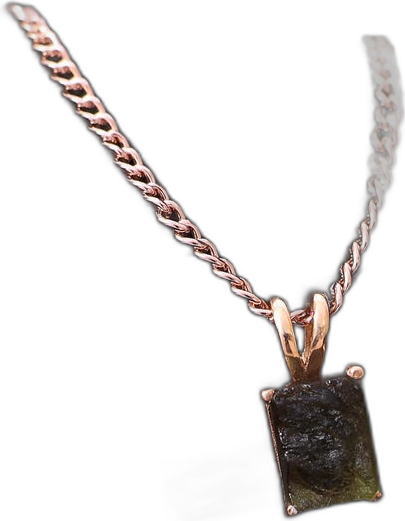
Moldavite
Earth's crust, turned to glass by a cosmic impact
14.8 million years ago, an asteroid slammed into what is now Bavaria with enough force to vaporise the ground. The molten glass rained across central Europe and solidified mid-flight. About 275 tonnes survive today. Erosion has destroyed 99% of what was created. No more will ever form — unless another asteroid hits.
Natural Pearl
A mollusk's slow answer to a grain of sand
One in ten thousand wild oysters produces a gem pearl. Every natural pearl that has ever existed would fit inside a single room. Of everything you could wear, this is the rarest thing in all of existence.
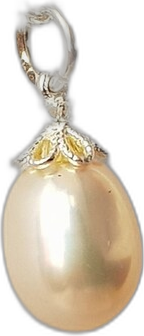
The rarest wearable material in the known universe
A natural pearl.
Not diamond. Not ruby. A small, quiet sphere built by a living creature, on the only planet known to have oceans, wrapped around an irritant grain by grain over years.
Every natural pearl that has ever existed — across all of history — would fit inside a single room.