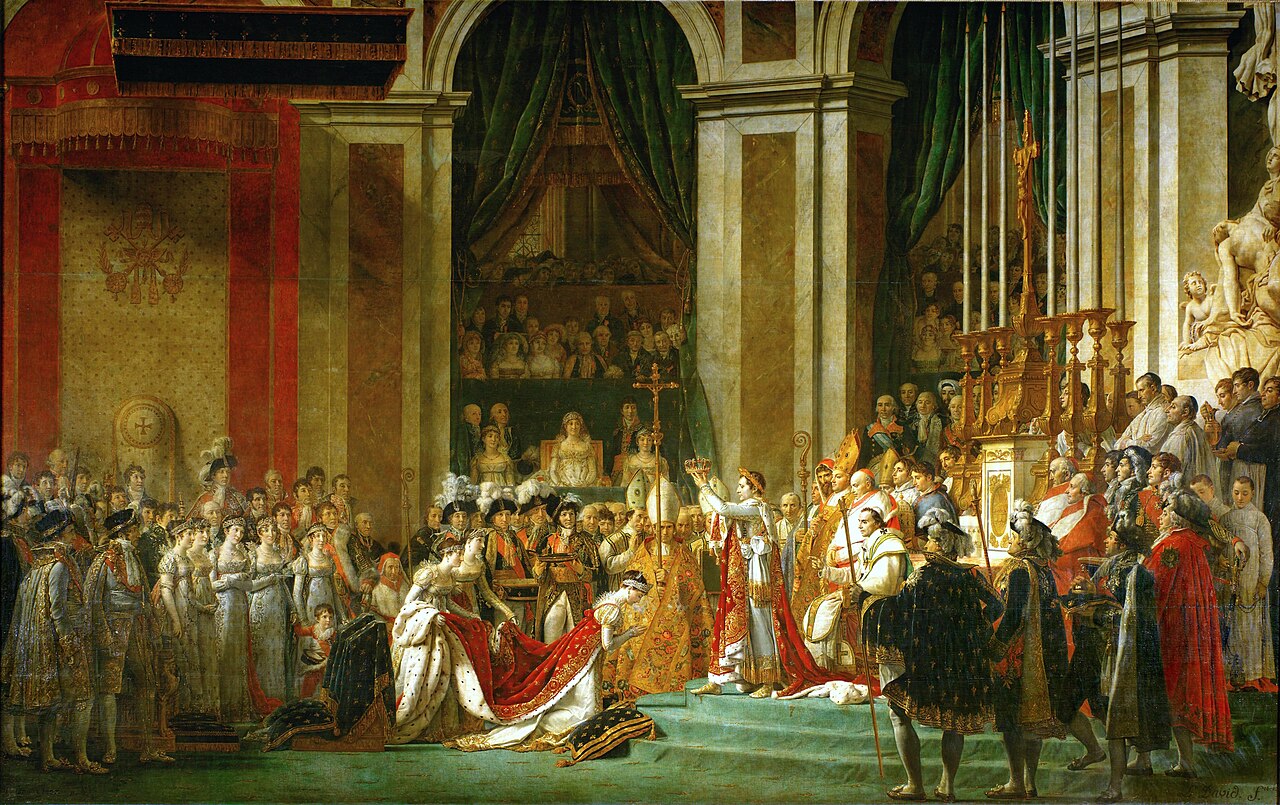
What Did Napoleon Bonaparte Look Like? | Faces Who Made History — AI reconstruction based on 5 historical sources
AI Reconstruction

Revolutionary & Napoleonic France · 1769–1821

Napoleon Bonaparte

Confidence: High confidenceDepicted age: ~35

Emperor of the French. Death masks, life masks, and dozens of paintings made from life give us an unusually precise picture. And he was not short.

How tall was Napoleon? The myth of the tiny emperor is just that — a myth. Napoleon stood about 5 feet 7 inches (170 cm) in modern measurements, which was average or slightly above average for a Frenchman of his era. The confusion stems from the difference between French and English inches: his recorded height of "5 pieds 2 pouces" in French units converts to roughly 5’7” in English. British caricaturists, particularly James Gillray, seized on the low number and ran with it.

We know what Napoleon looked like with unusual precision because he sat for multiple painters and sculptors during his lifetime, and two masks survive: a life mask made by Franz Anton von Zauner in 1805, and the famous Antommarchi death mask from 1821. These give exact facial geometry. Jacques-Louis David painted him from life, as did Antoine-Jean Gros, Robert Lefèvre, and Paul Delaroche (who used the death mask). The face they consistently show is broad and rounded, with a strong jaw, a prominent Roman nose, grey or blue-grey eyes, and dark hair worn in the signature "Napoleon" fringe.

By his final years on Saint Helena, Napoleon had gained considerable weight, and the death mask shows a fuller, heavier face than the lean young general of Italy. Constant, his long-serving valet, left detailed descriptions: clear olive complexion, fine white teeth, chestnut hair that darkened over the years, and hands so well-shaped that he was vain about them.
Physical Description

HeightAbout 5’7” (170 cm); average for the period. The "short" myth comes from confusion between French and English inches.Attested
BuildCompact, broad-shouldered; lean and wiry as a young general, increasingly stout from his late 30s onwardAttested
FaceBroad, oval, with strong bone structure; fuller and rounder with ageAttested
ComplexionOlive / sallow; clear skinAttested
EyesGrey or blue-grey; described as penetrating and intenseAttested
BrowBroad, prominent foreheadAttested
NoseStrong, straight, Roman-type; well-proportionedAttested
MouthWell-formed; fine teeth that he was proud ofAttested
Jaw & chinStrong jaw, prominent chin; squarer in youth, obscured by weight laterAttested
HairDark chestnut brown, fine and straight; worn in the forward-combed fringe that became his signatureAttested
Facial hairClean-shaven throughout his lifeAttested
CraniumLarge head relative to body; broad skullAttested
Distinguishing featuresThe forward-combed "Napoleon" hairstyle; penetrating grey eyes; large head on a compact frame; the habitual hand-in-waistcoat pose (a portrait convention, not a medical habit)Attested
ExpressionIntense, commanding; could shift instantly from charm to cold furyInferred

The Evidence

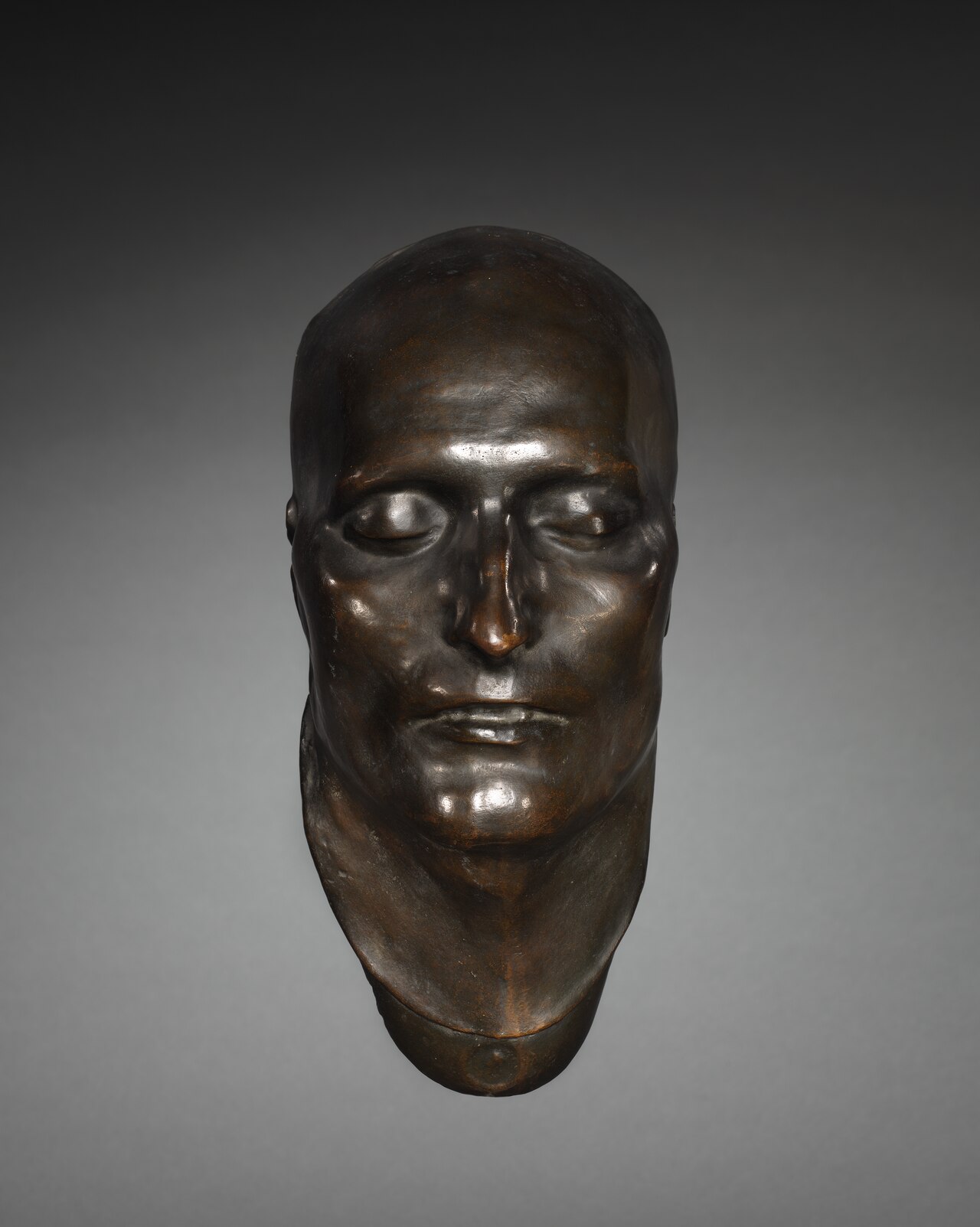
Death mask of Napoleon, made by Dr. Francesco Antommarchi, Saint Helena, 6 May 1821

Cleveland Museum of Art, CC0, via Wikimedia Commons

Death mask of Napoleon, made by Dr. Francesco Antommarchi, Saint Helena, 6 May 1821

Cast directly from Napoleon’s face within 40 hours of death. Multiple copies survive. Gives exact facial proportions, though shows the fuller face of his final years.

What this source tells us

FaceBroad, oval, with strong bone structure; fuller and rounder with ageAttested
BrowBroad, prominent foreheadAttested
NoseStrong, straight, Roman-type; well-proportionedAttested
MouthWell-formed; fine teeth that he was proud ofAttested
Jaw & chinStrong jaw, prominent chin; squarer in youth, obscured by weight laterAttested
CraniumLarge head relative to body; broad skullAttested

Life mask of Napoleon, attributed to Lorenzo Bartolini or Franz Anton von Zauner, c. 1805–1806

Cast from the living face during the height of his power. Shows the leaner, more angular features of his mid-30s before significant weight gain.

What this source tells us

FaceBroad, oval, with strong bone structure; fuller and rounder with ageAttested
BrowBroad, prominent foreheadAttested
NoseStrong, straight, Roman-type; well-proportionedAttested
Jaw & chinStrong jaw, prominent chin; squarer in youth, obscured by weight laterAttested
CraniumLarge head relative to body; broad skullAttested
Distinguishing featuresThe forward-combed "Napoleon" hairstyle; penetrating grey eyes; large head on a compact frame; the habitual hand-in-waistcoat pose (a portrait convention, not a medical habit)Attested

Autopsy report by Dr. Francesco Antommarchi, 6 May 1821, Saint Helena

Official autopsy giving precise body measurements, cause of death (gastric carcinoma), and physical condition at the time of death.

What this source tells us

HeightAbout 5’7” (170 cm); average for the period. The "short" myth comes from confusion between French and English inches.Attested
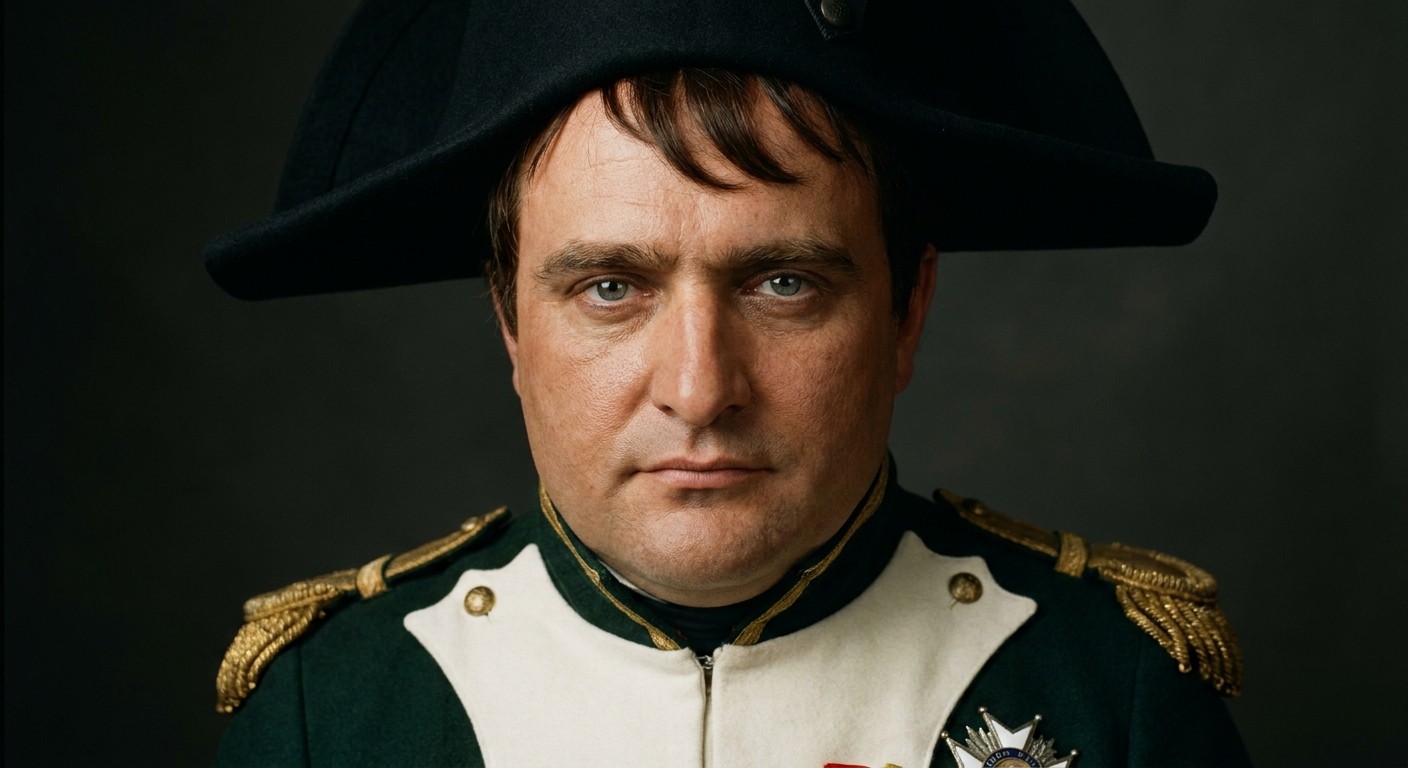
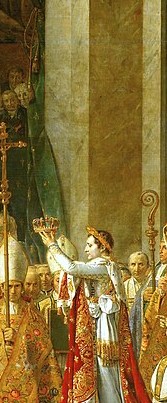
Jacques-Louis David, The Coronation of Napoleon (Le Sacre de Napoléon), 1805–1807, Musée du Louvre

Jacques-Louis David, Public domain, via Wikimedia Commons

Jacques-Louis David, The Coronation of Napoleon (Le Sacre de Napoléon), 1805–1807, Musée du Louvre

David was Napoleon’s official painter and had extensive access. While the coronation scene is staged, the face was painted from life sittings. One of the most authoritative visual records.

What this source tells us

BuildCompact, broad-shouldered; lean and wiry as a young general, increasingly stout from his late 30s onwardAttested
EyesGrey or blue-grey; described as penetrating and intenseAttested
NoseStrong, straight, Roman-type; well-proportionedAttested
HairDark chestnut brown, fine and straight; worn in the forward-combed fringe that became his signatureAttested
Facial hairClean-shaven throughout his lifeAttested
Distinguishing featuresThe forward-combed "Napoleon" hairstyle; penetrating grey eyes; large head on a compact frame; the habitual hand-in-waistcoat pose (a portrait convention, not a medical habit)Attested

Louis Constant Wairy, Mémoires de Constant, premier valet de chambre de l’Empereur, published 1830

Constant served as Napoleon’s personal valet for over a decade (1800–1814). His descriptions of Napoleon’s physical appearance, grooming, and habits are the most detailed and intimate surviving account.

His skin was smooth and his complexion clear, of an olive tint. His eyes were blue-grey, remarkably vivid and expressive. His teeth were fine and white, and he took care of them. His hands were admirably shaped, and he was rather vain of them.

What this source tells us

HeightAbout 5’7” (170 cm); average for the period. The "short" myth comes from confusion between French and English inches.Attested
BuildCompact, broad-shouldered; lean and wiry as a young general, increasingly stout from his late 30s onwardAttested
ComplexionOlive / sallow; clear skinAttested
EyesGrey or blue-grey; described as penetrating and intenseAttested
MouthWell-formed; fine teeth that he was proud ofAttested
HairDark chestnut brown, fine and straight; worn in the forward-combed fringe that became his signatureAttested
Facial hairClean-shaven throughout his lifeAttested
Distinguishing featuresThe forward-combed "Napoleon" hairstyle; penetrating grey eyes; large head on a compact frame; the habitual hand-in-waistcoat pose (a portrait convention, not a medical habit)Attested
ExpressionIntense, commanding; could shift instantly from charm to cold furyInferred

Where sources conflict

Height confusion: French ‘pieds’ and ‘pouces’ vs. English feet and inches led to decades of misunderstanding. His autopsy measurement converts to ~5’7” English.

Complexion: some British sources describe him as ‘sallow’ or ‘yellowish,’ which may reflect his chronic illness rather than his healthy appearance. French sources consistently say olive-complexioned.