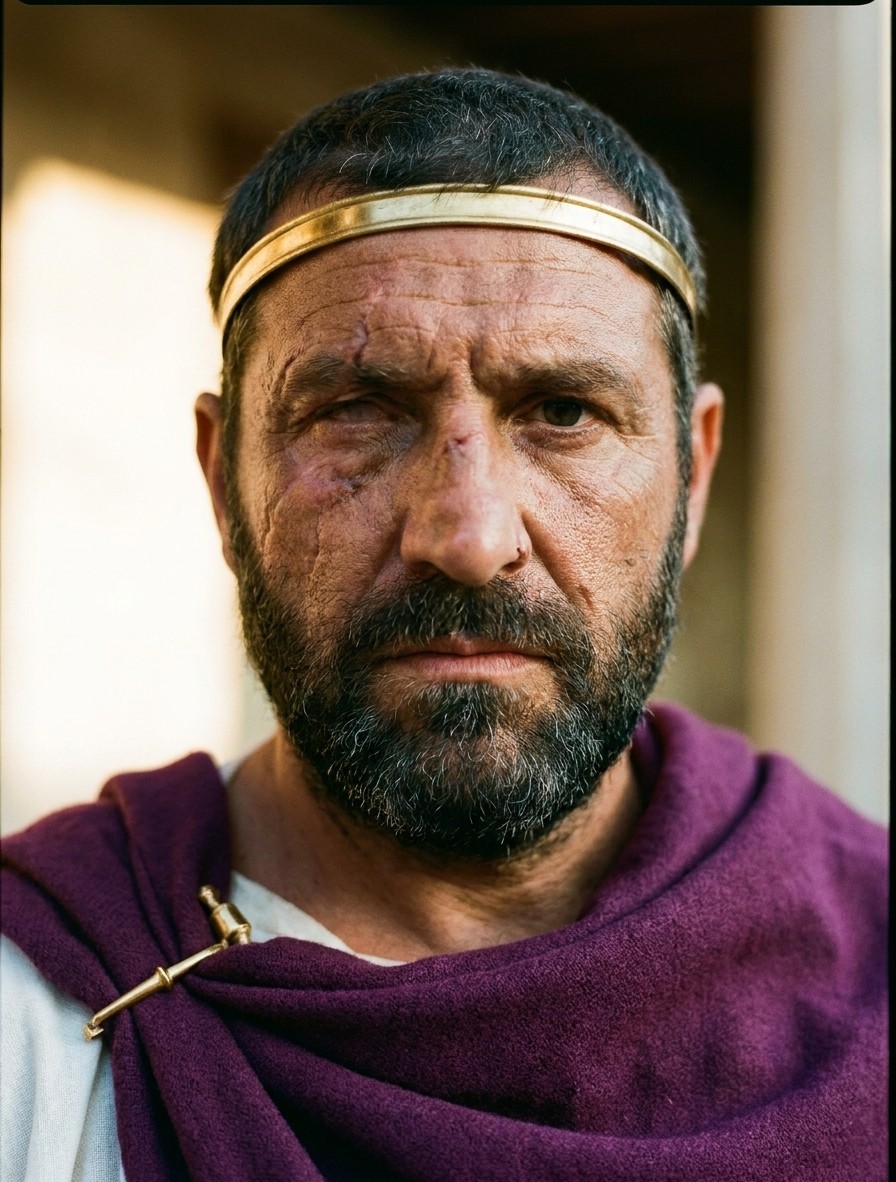
Philip II of Macedon은(는) 어떤 모습이었을까? | 역사의 얼굴들 — AI reconstruction based on 4 historical sources
AI 복원

Classical Greece · 382–336 BCE

Philip II of Macedon

신뢰도: 중간 신뢰도묘사된 나이: ~46

복원 근거

Alexander’s father, who unified Greece by force. He lost his right eye to an arrow at the siege of Methone in 354 BCE. The skull from the royal tomb at Vergina shows exactly that wound: a healed orbital fracture on the right side.

What did Philip II of Macedon look like? Alexander's father was a front-line fighter whose face showed it. He lost his right eye to an arrow at the siege of Methone in 354 BCE. Demosthenes, his political enemy in Athens, catalogued his injuries with contempt: "He had his eye cut out, his collar-bone broken, his hand and his leg maimed."

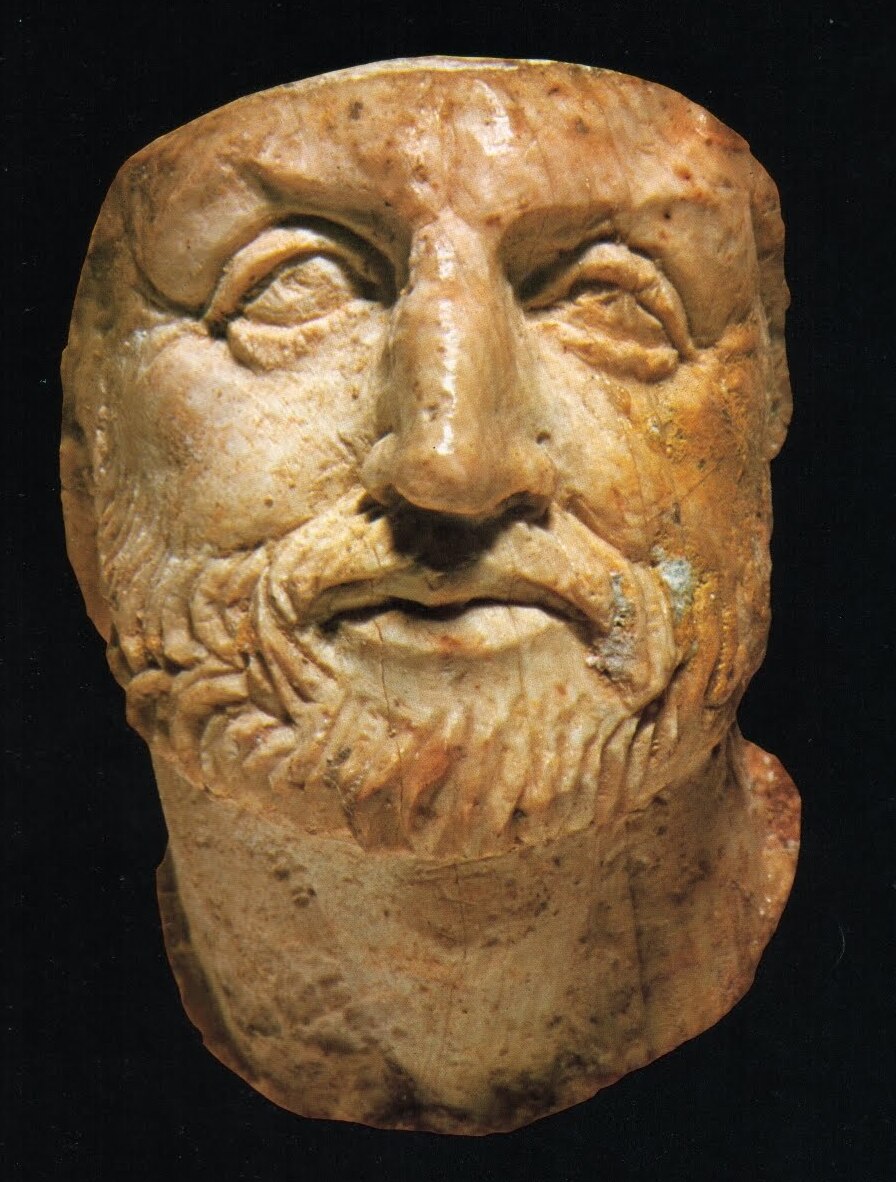
The skull from Tomb II at Vergina, if correctly attributed to Philip (as most scholars now believe), shows healed trauma to the right orbital area consistent with an arrow wound and surgical repair. Forensic teams have reconstructed his face from the bone: broad, strong-featured, with a heavy brow, a straight wide nose, a square jaw beneath a full beard. The ivory portrait heads found in the same tomb, likely contemporary works, show an intense man whose missing eye would have dominated any encounter with him.

Philip's height, build, complexion, and eye colour go unrecorded. He probably had a robust frame (he fought in the front ranks for most of his life) but that is inference, not evidence. His full beard was standard for Macedonian kings of his generation. It was his son Alexander who broke with the tradition. The biggest question mark is the tomb attribution itself: if Tomb II belongs to Philip III Arrhidaeus rather than Philip II, the skull evidence falls away.


신체적 특징

Not recorded; the skeleton from Vergina suggests average to above-average for the period추정
체격Robust, powerful; a lifelong warrior who fought personally in the front ranks추정
얼굴Broad, strong, square-jawed; a powerful, weathered face입증됨
안색Not recorded; fair is probable given Macedonian ancestry추정
Right eye destroyed by an arrow at Methone (354 BCE); left eye intact. No colour recorded.입증됨
눈썸Heavy, prominent; the right brow area shows healed trauma from the arrow wound입증됨
Broad, straight; possibly slightly asymmetric from the orbital wound입증됨
Wide; partially obscured by the beard in all depictions추정
턱과 턴Strong, broad jaw; square chin hidden beneath a full beard입증됨
머리카락Worn short; no colour recorded추정
수염Full beard, neatly trimmed; standard for a Macedonian king of the period입증됨
두개골Robust, well-developed; healed trauma on the right side from the arrow wound입증됨
Thick, muscular추정
두드러진 특징The destroyed right eye is the defining feature. Ancient sources describe Philip as battle-scarred: he lost the eye at Methone, broke his collarbone, and was lamed in the leg. He was a hard-used warrior-king, not a courtly figure.입증됨
표정Intense, commanding; the one-eyed gaze would have been striking and intimidating추정

증거

Skull from Tomb II, Royal Tombs at Vergina (ancient Aigai), excavated by Manolis Andronikos, 1977–78

If correctly attributed to Philip II, this is his actual skull. Shows healed trauma to the right orbital area consistent with an arrow wound and ancient surgical repair. Multiple forensic teams have reconstructed the face from the skull. The eye wound is the strongest evidence linking the remains to Philip II specifically.

이 자료가 알려주는 것

Not recorded; the skeleton from Vergina suggests average to above-average for the period추정
얼굴Broad, strong, square-jawed; a powerful, weathered face입증됨
Right eye destroyed by an arrow at Methone (354 BCE); left eye intact. No colour recorded.입증됨
눈썸Heavy, prominent; the right brow area shows healed trauma from the arrow wound입증됨
Broad, straight; possibly slightly asymmetric from the orbital wound입증됨
턱과 턴Strong, broad jaw; square chin hidden beneath a full beard입증됨
두개골Robust, well-developed; healed trauma on the right side from the arrow wound입증됨
두드러진 특징The destroyed right eye is the defining feature. Ancient sources describe Philip as battle-scarred: he lost the eye at Methone, broke his collarbone, and was lamed in the leg. He was a hard-used warrior-king, not a courtly figure.입증됨
Ivory portrait heads from Tomb II, Vergina. Archaeological Museum of Thessaloniki.

Ivory portrait heads from Tomb II, Vergina. Archaeological Museum of Thessaloniki.

Small chryselephantine (gold and ivory) portrait heads found in the antechamber of Tomb II. One is identified as Philip, the other as Alexander, based on apparent age and the damaged right eye of one figure. If correct, these are contemporary portraits — the closest thing to a photograph of Philip’s face.

이 자료가 알려주는 것

얼굴Broad, strong, square-jawed; a powerful, weathered face입증됨
Broad, straight; possibly slightly asymmetric from the orbital wound입증됨
Wide; partially obscured by the beard in all depictions추정
턱과 턴Strong, broad jaw; square chin hidden beneath a full beard입증됨
머리카락Worn short; no colour recorded추정
수염Full beard, neatly trimmed; standard for a Macedonian king of the period입증됨
Thick, muscular추정
표정Intense, commanding; the one-eyed gaze would have been striking and intimidating추정

Demosthenes, De Corona (On the Crown) 18.67; Didymus, Commentary on Demosthenes (1st c. BCE, preserving earlier sources)

Demosthenes was Philip’s political enemy and describes his wounds with hostile intent, but the physical facts are corroborated by the Vergina skull (eye) and other sources. This is the most detailed ancient account of Philip’s battle injuries.

He had his eye cut out, his collar-bone broken, his hand and his leg maimed — he abandoned to fortune every part of his body she cared to take, so long as he could live with what remained in honour and glory.

Various (Loeb Classical Library editions)

이 자료가 알려주는 것

Right eye destroyed by an arrow at Methone (354 BCE); left eye intact. No colour recorded.입증됨
두드러진 특징The destroyed right eye is the defining feature. Ancient sources describe Philip as battle-scarred: he lost the eye at Methone, broke his collarbone, and was lamed in the leg. He was a hard-used warrior-king, not a courtly figure.입증됨
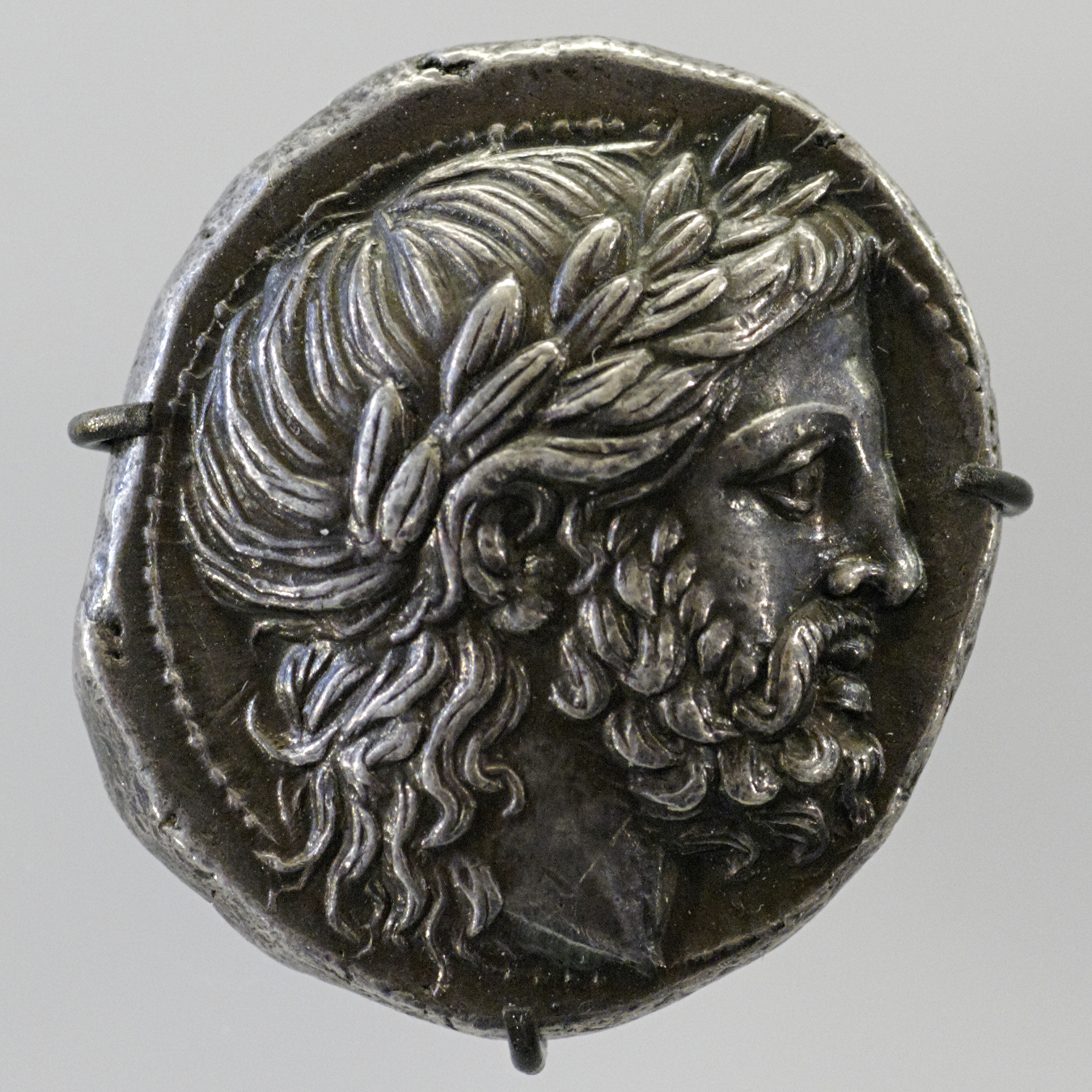
Silver tetradrachm of Philip II, various mints, c. 356–336 BCE

Silver tetradrachm of Philip II, various mints, c. 356–336 BCE

Philip’s coins show Zeus on the obverse and a horseman on the reverse — not Philip himself. Some scholars see Philippic features in the Zeus head, but this is highly speculative. The coins are useful for dating and context but not for physical likeness.

이 자료가 알려주는 것

수염Full beard, neatly trimmed; standard for a Macedonian king of the period입증됨

자료 간 상충되는 부분

The attribution of Vergina Tomb II to Philip II (rather than Philip III Arrhidaeus) is debated. Most scholars and the most recent analyses (including the eye-wound evidence) support Philip II, but it is not universally settled. If the tomb belongs to Philip III, the skull evidence would not apply.

The ivory portrait heads from Vergina are identified as Philip and Alexander on stylistic grounds, but there is no inscription. The identification is scholarly consensus, not proof.

Demosthenes’ descriptions of Philip’s wounds are hostile rhetoric — he was mocking Philip to Athenian audiences. The physical facts (eye, collarbone, leg) are likely accurate, but the tone is deliberately contemptuous.