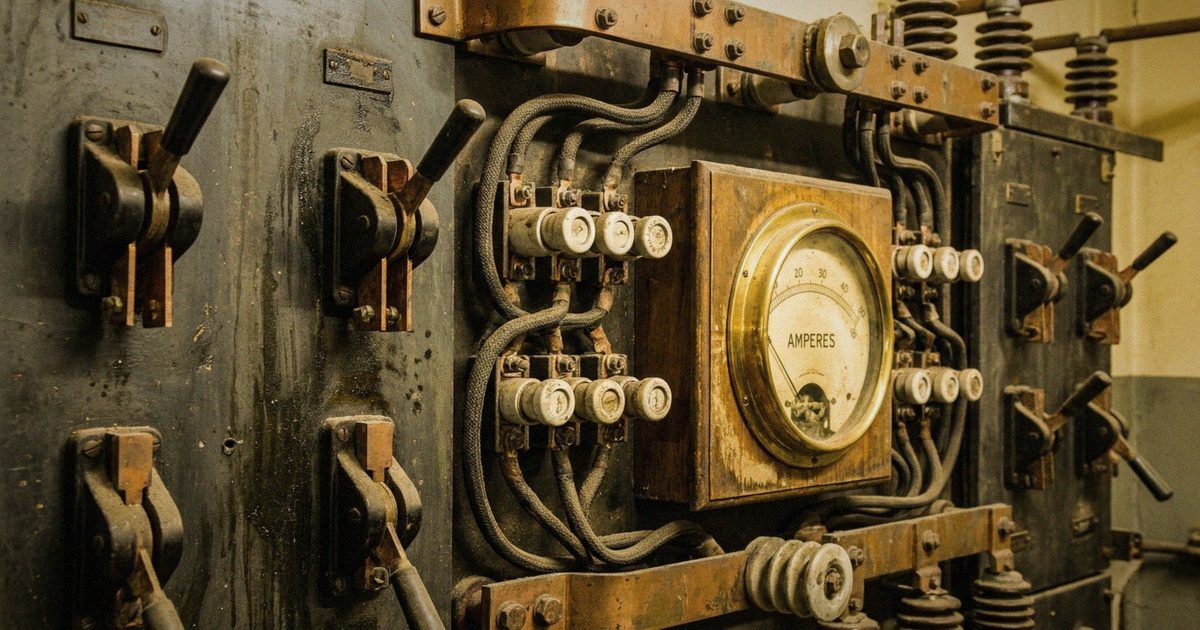
To understand AI, it’s worth recalling the rollout of electricity; one of the most transformative technologies in history.
Its first widespread use case was lighting. In 1882, Thomas Edison built the Pearl Street Station in New York City, the first central power plant, and its first customers were a cluster of printing houses and banks - businesses that operated after dark.
Street lamps and affluent homes followed. As demand grew, utilities built transmission lines to carry power further afield, and businesses and homes were wired and connected to the growing grid.
By the 1890s and early 1900s more use cases were discovered. Electric motors revolutionised industries such as textiles, mining, and manufacturing. Once industrial demand stabilised the technology and reduced costs, household adoption became widespread.
But many were sceptical, fearful, and even hostile towards electrification. The most vocal complaint was that it’s dangerous and will burn your house down. This wasn’t unjustified. Early electrical systems were wrapped in flammable cloth before safety standards were set.
Other criticisms were aesthetic - that electric lights were cold, ugly, and unnatural as well as unnecessary, inconvenient, and expensive. Electricity needed wires, but gas was cheap and you could use it anywhere.
But electricity also lit a room cleanly and instantly; no soot, no smoke, no gas smell. By the 1910s, electric light had gone from dangerous curiosity to symbol of progress and modern life.
In the 1920s and 1930s, new appliances like refrigerators, washing machines, and radios reshaped society. Falling prices and mass production made electricity accessible to the middle and working classes, turning it from a luxury into a basic utility.
Government programs in the 1930s gave it a final push. The U.S. Rural Electrification Act of 1936 extended access to rural areas, completing the foundation of a new, electrified society.
Entirely new, electricity-native use cases eventually emerged. They were innovations that weren’t just electric versions of older tools, but new capabilities made possible only by the medium itself. The telegraph and telephone collapsed communication time; radio and television created mass media; and later, computers and digital electronics transformed information.
An entire industrial and labor ecosystem emerged around electrification. At the top of the stack, power plant operators like Edison Electrical and Westinghouse became the first major players, supported by equipment manufacturers that produced turbines, dynamos, and transformers, and fuel suppliers that powered the new energy economy.
In the middle sat utility companies that managed grids, lines, and substations; regulatory bodies that set voltage and safety norms; and public utilities that governed access, billing, and regulation. At the edge of the network, electricians formed a new skilled trade; architects and engineers redesigned buildings to accommodate power; appliance makers such as GE, Westinghouse, and Hoover built products that became integral to modern life.
The rollout of AI echoes the early spread of electricity in striking ways. Today’s large AI models, developed by OpenAI, Anthropic, Google, and others are the central power plants of the AI era. The internet serves as the distribution grid, carrying intelligence instead of electricity.
But just as every building had to be individually wired before it could use electric power, every company will need to integrate AI into its own workflows. This requires skilled operators, the modern equivalent of electricians, who can connect, configure, and maintain AI systems so they work effectively within every organisation.
AI has already extended from enterprises to consumers, embedding itself in homes, schools, and personal devices. It will first replicate existing processes, like automating routine tasks and accelerating decision-making, before enabling entirely new use cases that are native to the technology itself.
It will also involve a whole stack economy. The large AI models are supported by compute infrastructure providers such as NVIDIA, Azure, and Google Cloud, which supply the digital “fuel” of processing power. Data providers sustain the flow of information that feed the models. In the middle sit the distribution layers of APIs and middleware like LangChain which act as the transmission lines, carrying intelligence to its points of use.
Integration platforms and consultancies, from Accenture and Deloitte to specialised startups are the AI utilities, helping enterprises connect these systems safely, while governance, compliance, and security vendors will establish standards and oversight, like early regulators in the electrification era.
At the edge of this network are the AI integrators and workflow engineers, which are the modern “electricians”, who design and maintain AI systems within organisations; product developers who build “AI appliances” such as copilots, agents, and domain-specific apps; and maintenance teams who fine-tune models with organisation-specific data.
As with electricity, this ecosystem is spawning new professions across the entire stack, forming what may turn out to be the backbone of a new economy built not on energy, but on intelligence.
There are some points of difference. First, scaling electrification required laying copper and steel across continents, taking decades and vast public investment. It evolved over half a century, allowing society time to adapt.
AI uses existing internet infrastructure and is rolling out rapidly. It evolves in months, not decades. Society’s adaptation curve will lag far behind AI’s innovation curve, so its impact will be far more volatile.
Some predictions:
- The next 10 years will compress the kind of economic and social transformation that electrification took 50 years to achieve.
- Electrification mechanised muscles. AI mechanises minds. Our minds will have to evolve from doing to directing. Workers will become orchestrators of AI agents rather than executors of tasks. We will need to train people for oversight and judgment.
- AI will become a general purpose utility, embedded into almost every digital process. Services won’t have to advertise that they use AI, it will be expected to be natively embedded in the product.
- Each layer of the AI economy will specialise, creating vast ecosystems of jobs and services. New professions will be created, like AI integrators and workflow architects, the equivalent of electricians and electrical engineers.
- As people become more familiar with AI, fear and skepticism will fade. Electricity was standardised through engineering and safety codes. But AI’s challenges are more philosophical than technical, concerning truth, bias, and privacy. There may be a patchwork of incompatible governance systems before convergence occurs into new global and national AI compliance frameworks.
- The first phase of AI will automate existing tasks; the next phase will invent AI-native applications that don’t have current equivalents. Entirely new categories of products and industries will be made.