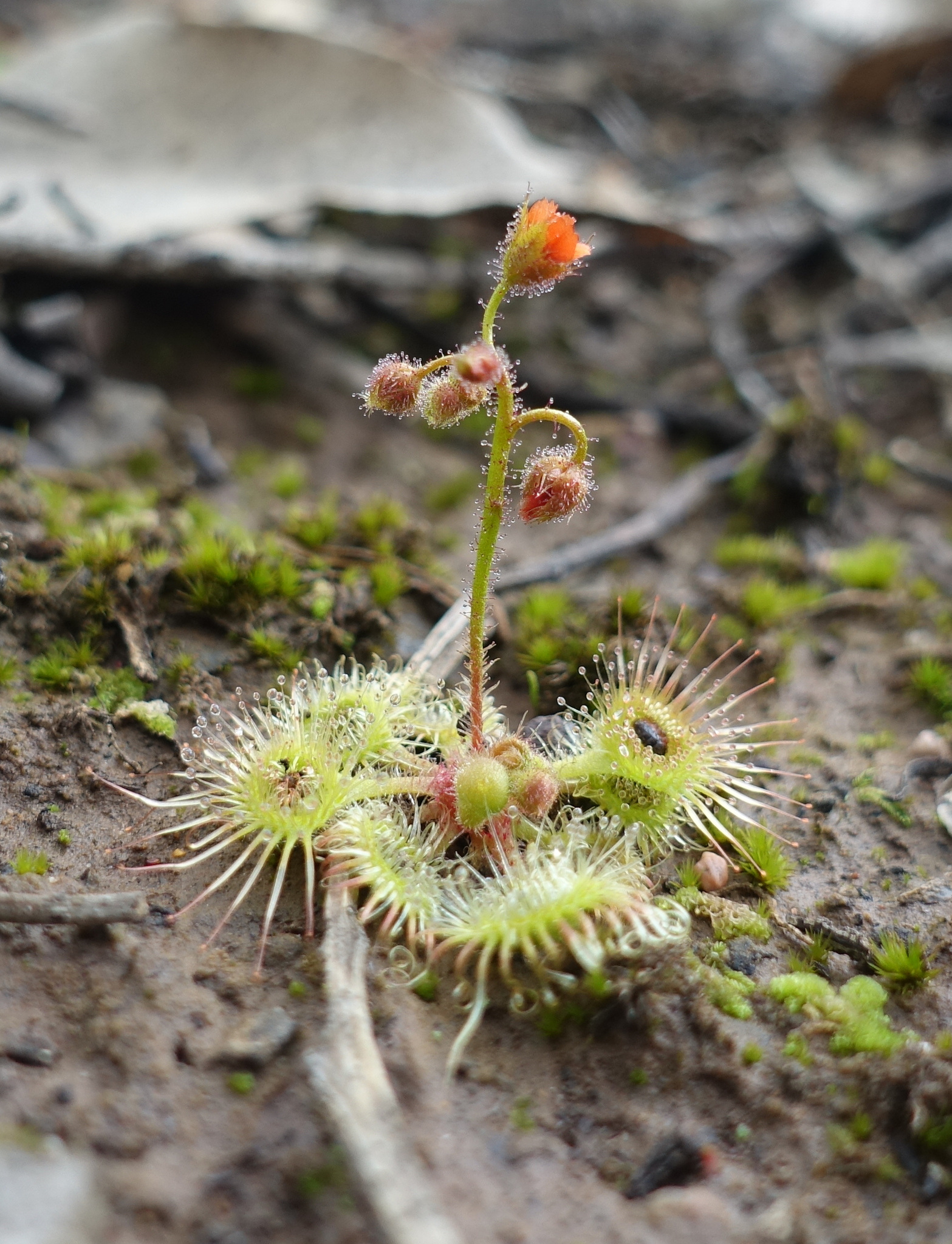
This sundew throws its food. Around the rim of each tiny cupped leaf stand a dozen or more dry tentacles. When a small walking insect brushes one, it swings inward, in some cases in as little as 75 thousandths of a second, and flings the insect onto the glue in the middle of the leaf.
Then the sticky tentacles slowly draw it down into the cup. Each catapult fires only once. The plant lives one short season, growing a new leaf every three or four days, so it can afford to spend them.
Richard Davion noticed it in 1974: the dry pads, he wrote, could "flick ants into the center of the traps". Almost no one paid attention until 2010. In 2012 researchers in Germany filmed it at 2,000 frames a second.
Its family includes the Venus flytrap, whose snapping trap probably evolved only once, from a sticky trap like a sundew's. No fossils show how. Researchers point to this sundew's tentacles as the kind of fast, touch-sensitive part a snap-trap could have been built from. But it isn't the flytrap's ancestor. It probably found its own way to speed.
Down at ground level, something small is walking towards the edge of a leaf.